The Big Picture
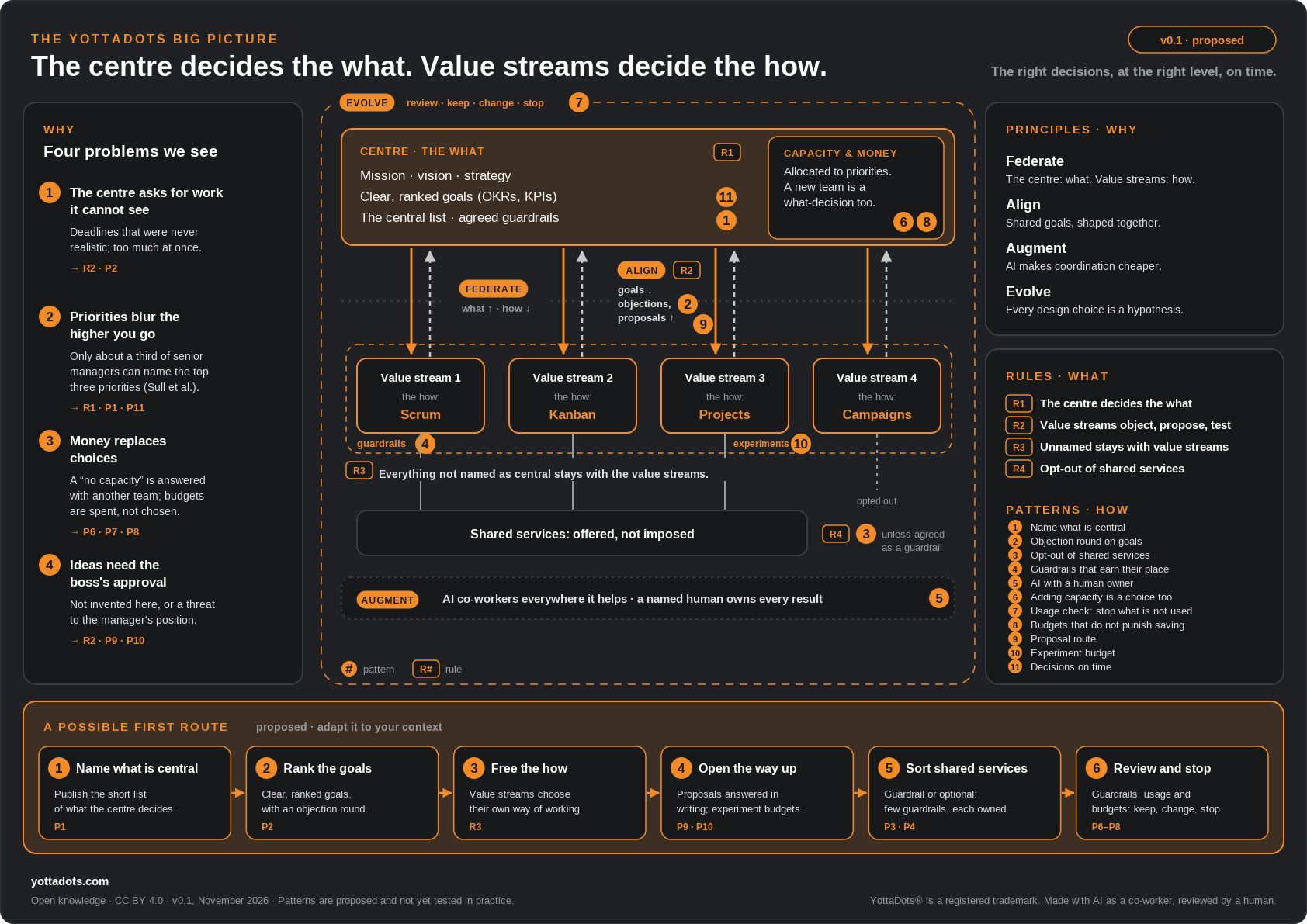
The whole method on one page: why YottaDots exists, how it works, and where to start. Its goal: the right decisions, at the right level, on time. Print it, put it on the wall, and use it in conversations.
Download
Two versions with the same content: a dark one for screens, and a light one that prints better and uses less ink.
| Version | Print (PDF, A3) | Source (SVG) |
|---|---|---|
| Light, for printing | SVG | |
| Dark, for screens | SVG |
The PDFs are A3 landscape and vector, so they also print sharply at A2, A1 or A0.
The poster is free to use, print, share and adapt under CC BY 4.0, with attribution. The name YottaDots® is a registered trademark; see the trademark policy.
How to read it
Left: why
Four problems YottaDots responds to. Each one points to the rule (R) or pattern (P) that addresses it.
- The centre asks for work it cannot see. Deadlines that were never realistic, and too much at once. → Rule 2, pattern 2.
- Priorities blur the higher you go. Only about a third of senior managers can name their company's top three priorities. → Rule 1, patterns 1 and 11.
- Money replaces choices. A "no capacity" is answered with another team; budgets are spent rather than chosen. → Patterns 6, 7 and 8.
- Ideas need the boss's approval. Not invented here, or a threat to the manager's position. → Rule 2, patterns 9 and 10.
More in Why YottaDots?
Middle: the model
- The centre decides the what: mission, vision, strategy, clear and ranked goals, the central list and agreed guardrails. It also allocates capacity and money to priorities; a new team is a what-decision too.
- Goals go down; objections, proposals and what the work takes come back up. Value streams can also test ideas within a small experiment budget.
- Each value stream decides its own how, with any method: Scrum, Kanban, projects, campaigns.
- Everything not named as central stays with the value streams.
- Shared services are offered, not imposed, unless agreed as a guardrail.
- AI co-workers help everywhere it is useful, with a named human owner for every result.
- A review loop around everything keeps, changes or stops what no longer works.
The four principles are shown where they act: Federate at the line between what and how, Align on the arrows, Augment on the AI band and Evolve on the loop.
Right: principles, rules and patterns
- Principles, the why: Federate, Align, Augment, Evolve.
- Rules, the what:
- the centre decides the what;
- value streams help shape it: they object, propose and test;
- what is not named stays with the value streams;
- value streams may opt out of shared services.
- Patterns, the how:
- name what is central;
- objection round on goals;
- opt-out of shared services;
- guardrails that earn their place;
- AI with a human owner;
- adding capacity is a choice too;
- usage check: stop what is not used;
- budgets that do not punish saving;
- proposal route;
- experiment budget;
- decisions on time.
Bottom: a possible first route
A suggestion, not a fixed roadmap. Adapt it to your context.
- Name what is central. Publish the short list of what the centre decides. (Pattern 1, Central List Canvas)
- Rank the goals. Clear, ranked goals, with an objection round. (Pattern 2)
- Free the how. Value streams choose their own way of working. (Rule 3)
- Open the way up. Proposals are answered in writing; value streams get a small experiment budget. (Pattern 9, pattern 10)
- Sort shared services. Guardrail or optional; few guardrails, each one owned. (Pattern 3, pattern 4)
- Review and stop. Guardrails, usage and budgets: keep, change or stop. (Patterns 6, 7 and 8)
Improve the poster
The poster is made the same way as the other visuals on this site: drafted by AI, reviewed by a human (see How we make visuals). Found an error, or an idea for a better version? Suggest an improvement.