The Central List Canvas
A worksheet for the first step of YottaDots: agree, in writing, what the centre decides. Everything that is not on the list stays with the value streams.
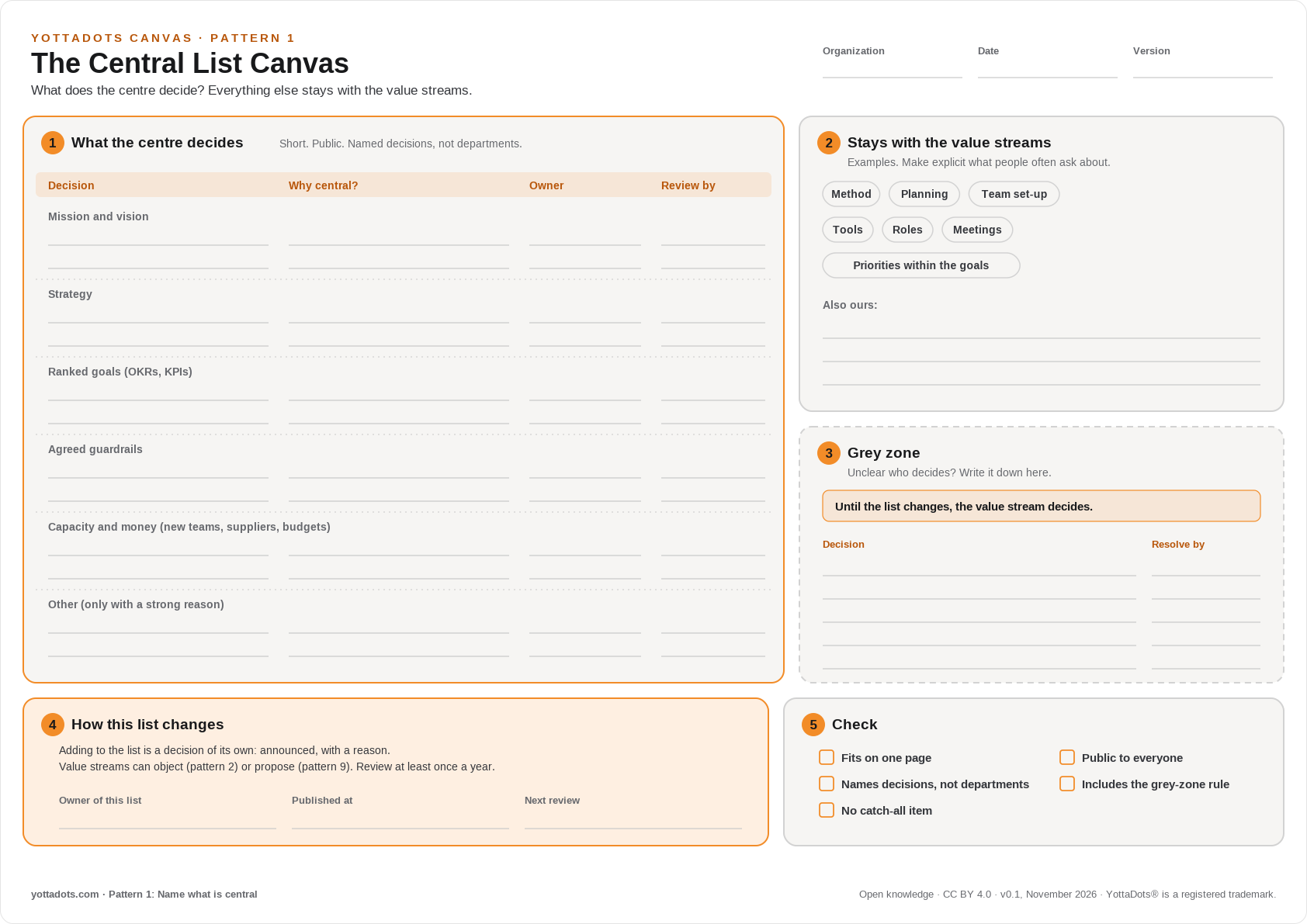
Download
| File | Use |
|---|---|
| PDF, A3 landscape | Print it, or put it on a wall. It is a vector file, so it also prints sharply at A2 or larger. |
| SVG | Use it on a digital whiteboard, or adapt it. |
The canvas is free to use, print, share and adapt under CC BY 4.0, with attribution.
When to use it
- At the start, as step 1 of the first route.
- When people often ask "who decides this?" or need permission for things nobody ever gave the centre.
- Once a year, to review the list and remove what the centre no longer needs to decide.
Who takes part
The centre (for example the board or management team) and representatives of the value streams. The centre owns the list; the value streams make sure it is complete and honest.
How to fill it in
A suggested workshop of about 90 minutes. Adapt it to your context.
| Step | Section | What to do | Time |
|---|---|---|---|
| 1 | 1. What the centre decides | The centre lists the decisions it takes today, row by row. For each one: why it must be central, who owns it, and when it will be reviewed. | 30 min |
| 2 | 1. (challenge) | The value streams challenge each line: is this a decision, or a department? Is the reason good enough? Could the value streams decide it? | 20 min |
| 3 | 2. Stays with the value streams | Make explicit what people often ask permission for today, such as tools, team set-up or meetings. | 10 min |
| 4 | 3. Grey zone | Write down every decision where nobody is sure who decides. Give each one a date by which it will be resolved. Until then, the value stream decides. | 15 min |
| 5 | 4. How this list changes | Name the owner of the list, where it will be published, and the next review date. | 5 min |
| 6 | 5. Check | Tick the five boxes. If one fails, fix it before you publish. | 10 min |
The five checks
- Fits on one page. A long list means the centre decides too much.
- Names decisions, not departments. "IT" is not a decision; "the approved cloud providers" is.
- No catch-all item. "And other matters of strategic importance" turns the list into a blank cheque.
- Public to everyone, not only to managers.
- Includes the grey-zone rule: when in doubt, the value stream decides.
Tips
- Start from real decisions, not from an organization chart. Ask: what did the centre decide in the last three months?
- Capacity and money have their own row on purpose: a new team, supplier or budget is a decision about the what (see Adding capacity is a choice too).
- Guardrails on the list should each pass the guardrail test.
- Changing the list later is a decision of its own. Value streams can object (pattern 2) or propose (pattern 9).
Share what happened
Used the canvas? Tell us what worked and what did not in a GitHub issue. Real cases are how patterns move from proposed to accepted.